













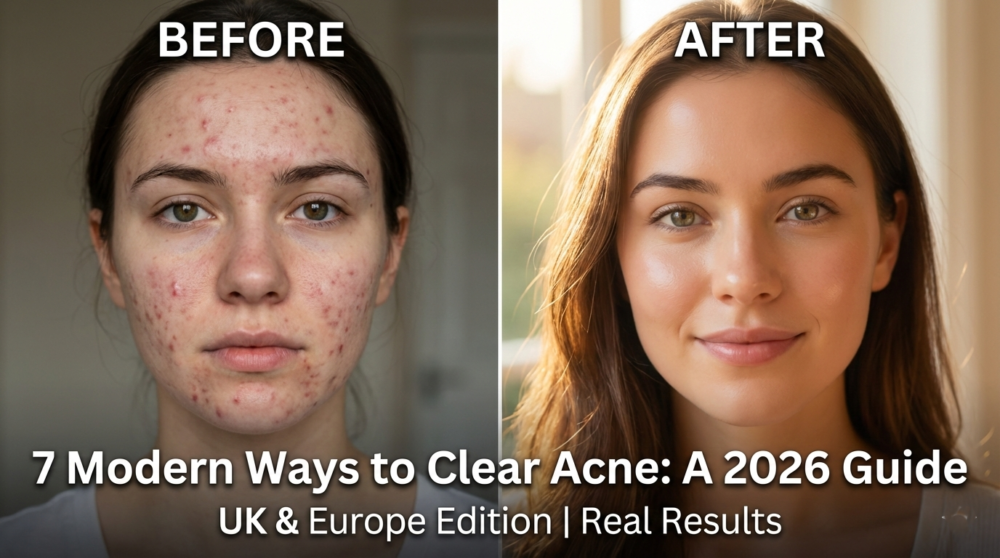
Finding a way to clear your skin often feels like trying to solve a puzzle where the pieces keep changing shape. If you’ve ever woken up, looked in the mirror, and felt that sinking feeling because a fresh breakout decided to join you for an important day, you aren’t alone. Across the UK and Europe, adult acne is on the rise, and the old advice of “just wash your face more” simply doesn’t cut it in 2026.
We now know that clear skin isn’t just about what you put on your face; it’s about understanding the complex biology of your body. From the cobblestone streets of London to the clinics of Paris, dermatologists are shifting away from harsh chemicals and moving toward regenerative, microbiome-friendly solutions.
Here are 7 science-backed, human-centered tips to help you reclaim your complexion, featuring the latest research from 2025 and 2026.
1. Stop “Nuking” Your Microbiome: The Rise of Probiotics
For decades, the standard response to acne was to kill everything. We used harsh antibacterial soaps and long-term antibiotics that acted like a “scorched earth” policy on our skin. Recent 2025 research published in the Journal of Clinical Dermatology has confirmed what many of us suspected: when we kill the “bad” bacteria , we often kill the “good” bacteria that protect us, too.
The Story: Think of your skin like a garden. If you spray weedkiller on everything, nothing grows, and the soil becomes barren. Instead, modern skincare is about “weeding and seeding.”
The Tip: Look for cleansers and serums that contain prebiotics or plant-derived monoterpenes. These ingredients don’t just kill bacteria; they rebalance your skin’s ecosystem. In a recent UK-based study, participants using a “microbiome-balancing” wash saw a significant reduction in inflammation within just four weeks, without the dryness associated with traditional benzoyl peroxide.
2. Guard Your Glucose: The Sugar-Acne Connection
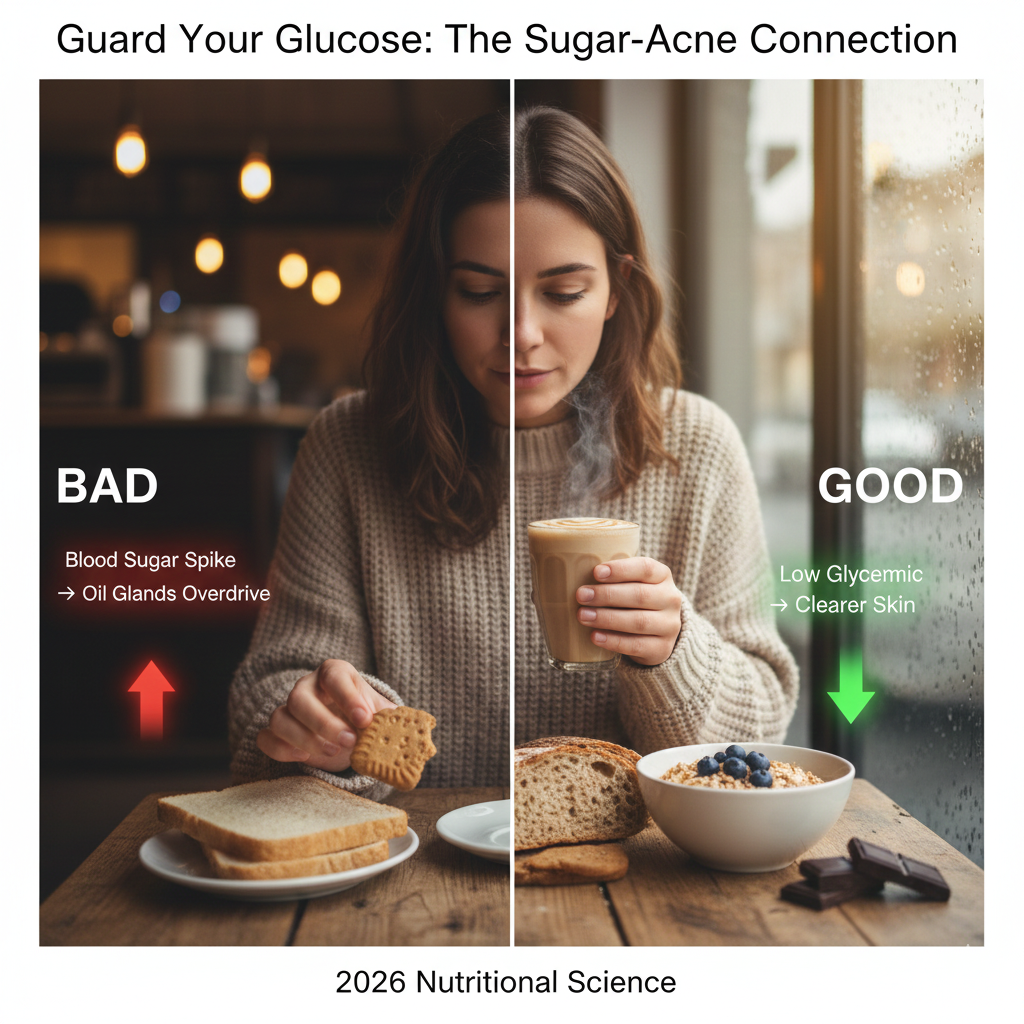
It’s a rainy Tuesday in Manchester, and you reach for a digestive biscuit and a sweetened latte. We’ve all been there. However, 2026 nutritional science has drawn a very firm line between blood sugar spikes and sebum production.
When your blood sugar spikes, your body releases insulin. This insulin surge triggers a cascade of hormones (like IGF-1) that tell your oil glands to go into overdrive.
The Tip: You don’t have to give up bread and chocolate forever. Instead, focus on the Glycemic Load. A 2025 systematic review found that individuals who moved to a low-glycemic diet—swapping white bread for sourdough or oats, and opting for berries over tropical fruits—reduced their acne severity by nearly 30% over three months.
3. Embrace “Skin minimalism”: Less is Actually More
There was a time, around 2022, when a 12-step skincare routine was a status symbol. Today, in 2026, we call that “barrier sabotage.” Over-exfoliating with multiple acids (AHAs, BHAs, and Retinols all at once) thins the skin barrier, making it easier for bacteria to penetrate and cause cystic breakouts.
The Story: Imagine wearing three heavy coats in the middle of summer. Your skin can’t breathe, it gets irritated, and it eventually reacts.
The Tip: Follow the “Rule of Three.” Your morning routine should only consist of a gentle cleanser, a targeted treatment (like Vitamin C or Niacinamide), and a high-quality SPF. Your night routine should be a double-cleanse, a treatment (like a retinoid), and a barrier-repair moisturizer. If your face feels “tight” after washing, your cleanser is too harsh. European favorites like La Roche-Posay and CeraVe have pioneered these “barrier-first” formulas for a reason.
4. The Future is Here: Exosomes and PDRN
If you keep up with the latest aesthetic trends in Berlin or London, you’ve likely heard of Exosomes. As of 2026, this is the “gold standard” for regenerative skincare. Unlike traditional ingredients that just sit on the surface, exosomes are tiny “messenger” particles that tell your cells to repair themselves.
The Science: Research from late 2025 shows that $Lactobacillus$-derived exosomes can significantly reduce post-inflammatory hyperpigmentation (the red or dark marks left after a pimple).
The Tip: Look for “Regenerative Serums” containing PDRN (derived from salmon DNA) or Exosomes. These are especially helpful if you struggle with “adult acne” where the skin doesn’t heal as fast as it used to. They help the skin “remember” how to be healthy, speeding up the disappearance of scars without the need for aggressive lasers.
5. Sync with Your Hormonal Clock
Acne isn’t random. For many women in the UK and Europe, breakouts follow a predictable monthly pattern. New “Hormone-Synced” skincare routines are becoming mainstream in 2026.
The Story: During the week before your period, progesterone rises, which can cause your pores to tighten and trap oil. This is why you often get that “one big chin pimple” right on schedule.
The Tip: Adjust your ingredients based on your cycle.
-
Week 1-2 (Post-Period): Focus on hydration and glow (Vitamin C).
-
Week 3-4 (Pre-Period): Switch to “pre-emptive” care. Use a 2% Salicylic Acid wash or a Niacinamide serum to keep pores clear before the oil surge happens.

6. The “Blue Light” and Circadian Rhythm Factor
We spend our evenings scrolling through phones in London flats or watching TV in Paris apartments. Emerging research has shown that Artificial Blue Light at night disrupts our skin’s circadian rhythm. Your skin has a “night mode” where it focuses on repair; blue light tricks it into staying in “day mode” (protection), leading to stalled healing and more inflammation.
The Tip: Implement a “Digital Sunset” for your skin. Use blue-light-filtering screen protectors, but more importantly, use skincare that contains Lutein or Malachite extract, which helps shield the skin from digital oxidative stress. Ensure you get at least 7 hours of sleep; the “beauty sleep” adage is actually a biological necessity for clearing acne.
7. Mind Your Water: The “Hard Water” Trap
If you live in London, South East England, or parts of Central Europe, you likely have “hard water.” This water is high in minerals like calcium and magnesium, which can react with soaps to create a “scum” that clogs pores and irritates the skin.
The Story: You buy the most expensive face wash, but the water you’re using to rinse it off is actually the culprit behind your persistent redness.
The Tip: Many Europeans are now switching to Micellar Water for their final rinse or installing a shower filter. A simple trick? After washing your face with tap water, do one final “swipe” with a cotton pad soaked in a gentle, pH-balanced micellar water (like Bioderma) to remove mineral residue. It’s a game-changer for sensitive, acne-prone skin.
Quick Comparison: Old Way vs. The 2026 Way
| Feature | The “Old” Way (2020) | The “New” Way (2026) |
| Primary Goal | Kill all bacteria | Balance the microbiome |
| Cleansing | Squeaky clean/Stripped | PH-balanced/Supple |
| Diet Focus | “Greasy food” myths | Glycemic index & Insulin |
| Technology | Harsh Chemical Peels | Exosomes & PDRN |
| Philosophy | Cover-up & Conceal | Regenerate & Repair |
Healing your skin is a marathon, not a sprint. We often want overnight results because our faces are our primary way of interacting with the world. But remember: your skin is an organ, and it’s doing its best to protect you.
If you’ve tried everything and your acne is still persistent or painful, don’t hesitate to visit a GP or a Consultant Dermatologist. In the UK, the NHS and private clinics now have access to “Biostimulatory” treatments that can help when topical creams aren’t enough.
You deserve to feel confident in your own skin. By choosing smarter, more humanized care, you aren’t just removing acne—you’re building long-term skin resilience.